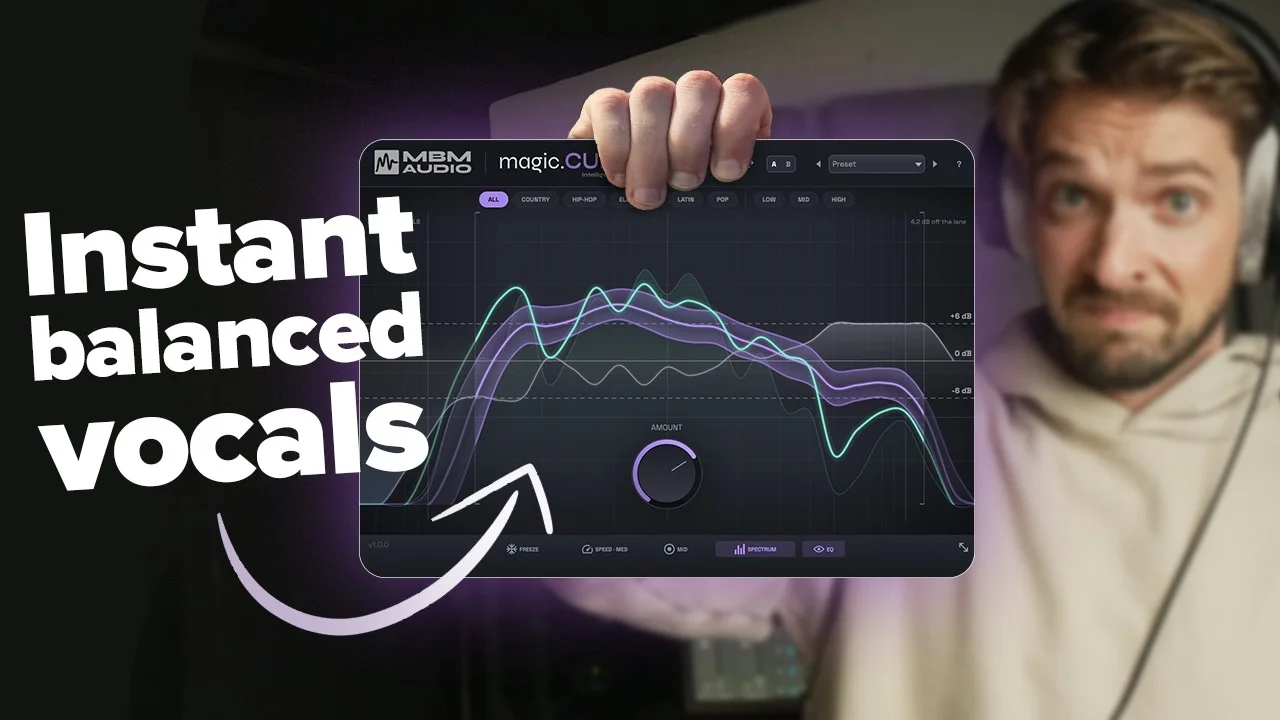
I Turned 3,054 Hit Songs Into One EQ Plugin
I took over 3,000 hit songs and analyzed their vocal EQ. I took their EQ and turned them into a plugin that automatically makes your vocal sound more like the h
Key Takeaways
- Most hit vocals across 35 years live within a surprisingly narrow 5dB EQ window
- Cut the sub-bass, keep body in the low mids, dip around 5kHz, add a high shelf
- The 5kHz dip shows up constantly - it's likely a human anatomy thing
- EQ won't fix a bad room, a bad take, or broken compression - it's one piece of the puzzle
- magic.CURVE analyzes your vocal and matches it to the hit curve automatically
There I was, making the same EQ move for like the hundredth time.
Cut here. Boost there. And yeah - it sounded pretty good.
But there’s always this thing that creeps in. Is it actually good?
I also made a full video on this…
All the ideas in this article come from the video below. If you don't feel like reading, well, I gotchu.
Or have I just spent the last 12 years getting really comfortable with my own mistakes?
There’s only one way to find out. Compare my vocals to the pros.
So I did what any obsessive music producer with way too much time on his hands would do - I downloaded 3,054 hit songs from the past 35 years, separated out the vocals, and measured every single one of them.
And it turns out some of the moves I’d been making were pretty close.
How I Got Obsessed With Vocal Tone in the First Place
Twelve years ago I bought my first pair of studio monitors and my first microphone. I still have that mic sitting right here.
That’s the mic I recorded the first song I ever wrote on. And after recording it, I shared it with literally everyone I knew. I thought it was incredible. I thought I was the second coming of Paul McCartney.
Then I pressed play.
Spoiler alert: it sounded terrible.
In fact, I’m pretty sure some of those early tracks were briefly used to torture prisoners of war - until the UN decided that even that violated the Geneva Convention.
But making terrible tracks didn’t discourage me. It did the opposite. It made me obsess over one question:
Why do hit records sound like hit records, and why do mine sound like doo-doo?
So I learned everything I could and started fixing things one at a time. Better microphones. Better rooms. I even worked on my actual singing.
But out of everything on that journey, the thing that took me the longest to hear correctly - and to feel confident about - was vocal tone. The EQ. The actual frequency balance of the vocal itself.
Why Vocal EQ Is So Hard to Learn
EQ is brutal to learn because it’s so variable.
- How far you are from the mic changes it
- Which mic you’re using changes it
- What your voice naturally sounds like changes it
- The room you tracked in changes it
And then on top of all that variability, it’s subjective. It requires taste. Which means there’s no simple formula somebody can hand you.
But here’s the thing that started nagging at me.
If EQ is truly subjective and taste-based… why do I keep making the same moves over and over again?
I can’t be the only producer on earth who likes boosting the top end and cutting the mud out of a vocal. Surely there’s a pattern.
So instead of guessing, I went and got the data.
I Measured 3,054 Hit Vocals
I pulled every Billboard hit I could find over the last 35 years. Thousands of the most famous, most successful, most streamed songs ever recorded.
And then I stacked them all on top of each other on one chart.
That’s when the pattern showed up.
Across 35 years and every genre, the majority of hit vocals land within a five decibel window.
Five decibels. That’s it. Thousands of songs, hundreds of engineers, dozens of genres, three and a half decades of changing production trends - and they’re all crowding into the same narrow lane.
Two songs that should sound nothing alike
Want a concrete example? Take Spice Girls - “Wannabe” and Hozier - “Too Sweet.”
One is a bubblegum pop record from the ’90s with a female vocalist. The other is a moody blues-inflected record from a male vocalist released over 30 years later.
Their vocal EQ curves are almost identical.
Different singers. Different genders. Different genres. Different decades. Different studios, different mics, different engineers, different everything.
Same curve.
What the Curve Actually Looks Like
Let me be careful here, because I don’t want this to be misread.
This does not mean there’s one perfect EQ curve that works on every vocal. Taste is still real. The choices are still yours to make.
But what it does mean is that there’s a curve underneath all of it. A center of gravity that most hit vocals drift toward.
Here’s the shape:
- Sub-bass is mostly gone. The very bottom gets cut out. There’s nothing useful down there for a vocal - just rumble, proximity buildup, and mud.
- The body lives in the low mids. This is where the weight and warmth of the voice sits. It’s present, but controlled.
- The curve slopes gently downward through the mids.
- There’s a dip around 5kHz. This one shows up constantly.
- A high shelf brings back sheen and brightness up top.
Why the 5kHz dip keeps showing up
This is the part I find genuinely fascinating.
That 5K dip appears in an enormous number of hit vocals, and I don’t think it’s purely an aesthetic choice. My theory is that it’s anatomical.
The human voice doesn’t naturally produce a ton of energy at 5kHz. We produce plenty of energy lower down - chest voice and head voice sit in the mid-range - and we produce plenty above it with sibilance, the “s” and “sh” sounds up in the top end.
But 5K itself? That’s kind of a dead zone for how the human vocal tract works. So when engineers shape a vocal to sound natural and pleasant, they end up carving there almost by instinct.
Takeaway: the hit curve isn’t arbitrary. It’s tracking how human voices actually work.
What This Curve Won’t Fix
Let me be real with you, because I hate when people oversell this stuff.
This curve helps. A lot. But it’s not everything.
Twelve years of experience has taught me there’s a whole pile of other stuff that goes into a professional-sounding vocal, and EQ can’t rescue any of it:
- It won’t fix a bad room. Reflections and boxiness are baked into the recording.
- It won’t fix a bad take. Pitchy, low-energy, unconfident performances stay pitchy, low-energy, and unconfident.
- It won’t fix your compression. Dynamics are a separate problem entirely.
EQ is one thing. But in my opinion it’s one of the biggest things - and it’s the thing that personally took me the longest to train my ears for.
Which is exactly why I wanted to share it.
The Comment Section Made Me Build a Plugin
I made a whole video breaking down this research - the curve, what I learned, how to apply it manually.
People liked it. But the comments kept saying the same thing over and over:
“Make it a plugin.”
And honestly? I get it.
Knowing the shape is one thing. Actually adjusting your EQ so your vocal fits into that shape is a completely different skill.
Because to do it by hand, you need to be able to hear which frequencies are off in your specific vocal, on your specific mic, in your specific room. That kind of ear training takes years.
Most people don’t have years.
So I went back to the lab and built the one tool I wish I’d had when I first started recording myself.
Meet magic.CURVE
It’s called magic.CURVE - and shout out to my comment section, who literally named it for me.
Here’s how it works:
- Drop it on any vocal.
- It analyzes the vocal automatically.
- It builds an EQ curve to move your vocal toward the hit curve. Drop it on any vocal.
You can choose the genre you want to sound most like, and you can choose your vocal type - low, medium, or high.
The difference is immediate. On the vocal I tested, it cut out a chunk of unnecessary low end and added the high-end presence the raw take was missing. The before-and-after is not subtle - the processed version just sounds present and ready to go, in one click.
The part I’m most proud of
Here’s what makes it more than a static preset.
It analyzes your voice continuously.
So if you’ve got a section where you drop into a low chest voice, or a part where you moved closer to the mic and picked up extra proximity effect, that section needs a different EQ than the rest of the take.
magic.CURVE recognizes that and adjusts accordingly.
Way less work on your end for genuinely good results.
But Can a Plugin Really Beat Doing It By Hand?
I know exactly what you’re thinking. A plugin like this can’t possibly be as good as doing it manually. It can’t replace 12 years of experience.
Honestly? I thought the same thing.
Which is why I’m running a blind shootout - me versus the plugin. My 12 years of EQ experience against one click.
I’ll be posting the results, and I’m genuinely not sure who’s going to win. That’s what makes it worth doing.
How to Get It Early
If this sounds like something that would actually help your workflow, the waitlist is open right now.
- Everyone on the waitlist locks in the founding member price of $39
- Normal price will be $59
- That’s a 34% discount just for showing up early
- Official release date: July 7th
Why I Actually Made This
It took me 12 years to get to the point where I trust my ears on vocal EQ. Twelve years of second-guessing, of A/B-ing against reference tracks, of wondering whether the thing I was hearing was good or just familiar.
I wish someone had handed me a shortcut. Not a replacement for learning - a starting point. Something that got my vocal tone into the right neighborhood so I could focus on everything else.
If you’ve ever played back a vocal and it just… doesn’t sit right? Something feels off and you can’t name it?
I made this for you.
Not sure what’s wrong with your vocal? Run it through my free Vocal Analyzer - it scores your vocal from 0 to 100 and gives you specific recommendations on what to fix first.
About Mattie
Mattie is a music producer, songwriter, and educator specializing in Logic Pro and vocal production. With over 10 years of experience in the music industry, he's helped thousands of artists transform their home studio recordings into professional-quality tracks.
As the founder of Music By Mattie, he creates tutorials, presets, and courses that simplify complex production techniques. His mission is to make professional music production accessible to everyone, regardless of budget or experience level.