How Loud Should Vocals Be? I Measured 3,054 Hit Songs
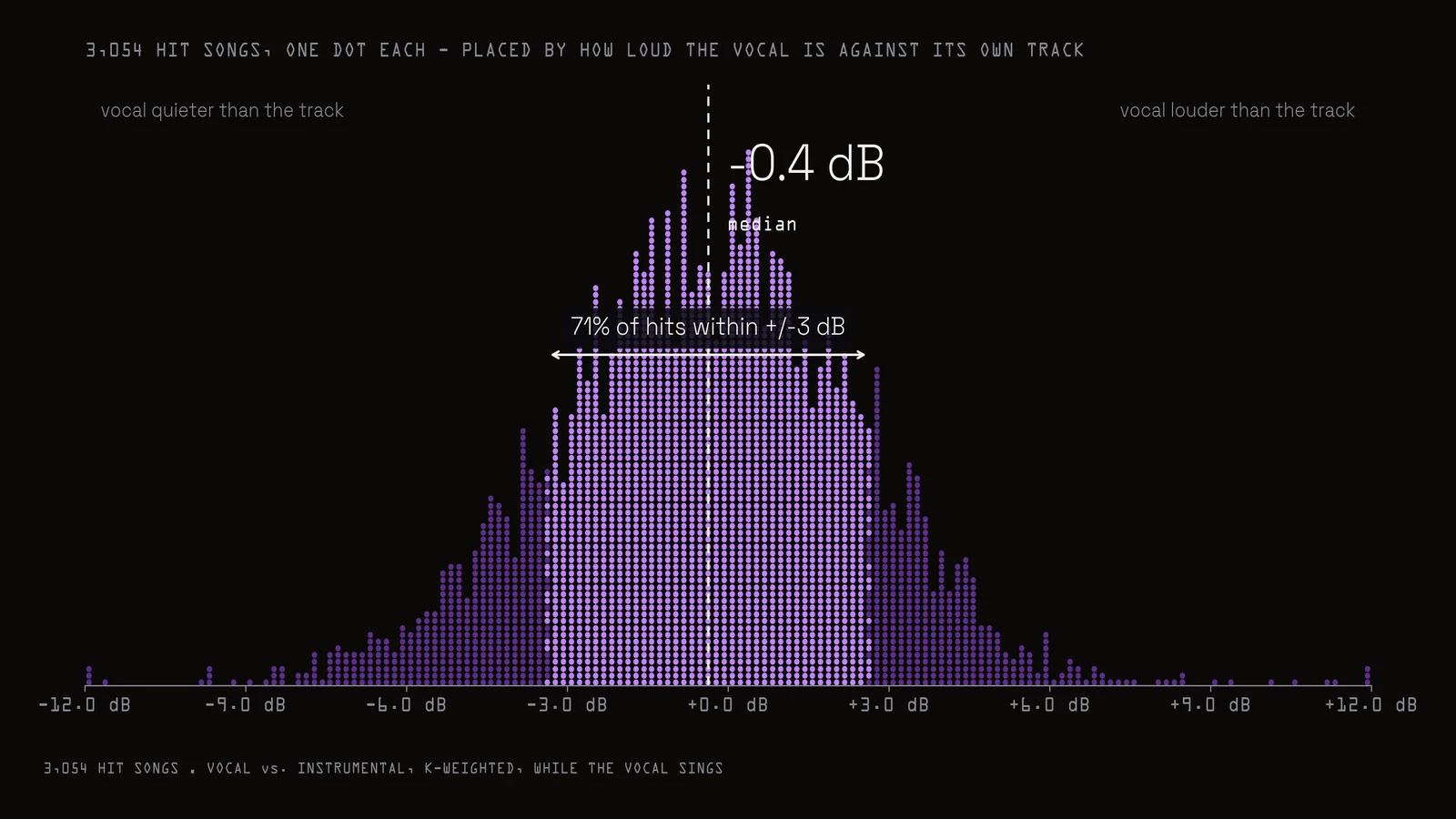
I measured the vocal level of 3,054 Billboard hits against their own instrumentals, only while the vocal is singing. The answer is a number: -0.4 dB....

Key Takeaways
- Hit vocals sit level with the track, not on top: -0.4 dB across 3,054 hits.
- Genre moves it 5 dB: country +2.2, hip-hop -3.2. Use your genre's window, not the average.
- Measure yours in three steps with any LUFS meter, or let the free analyzer do it.
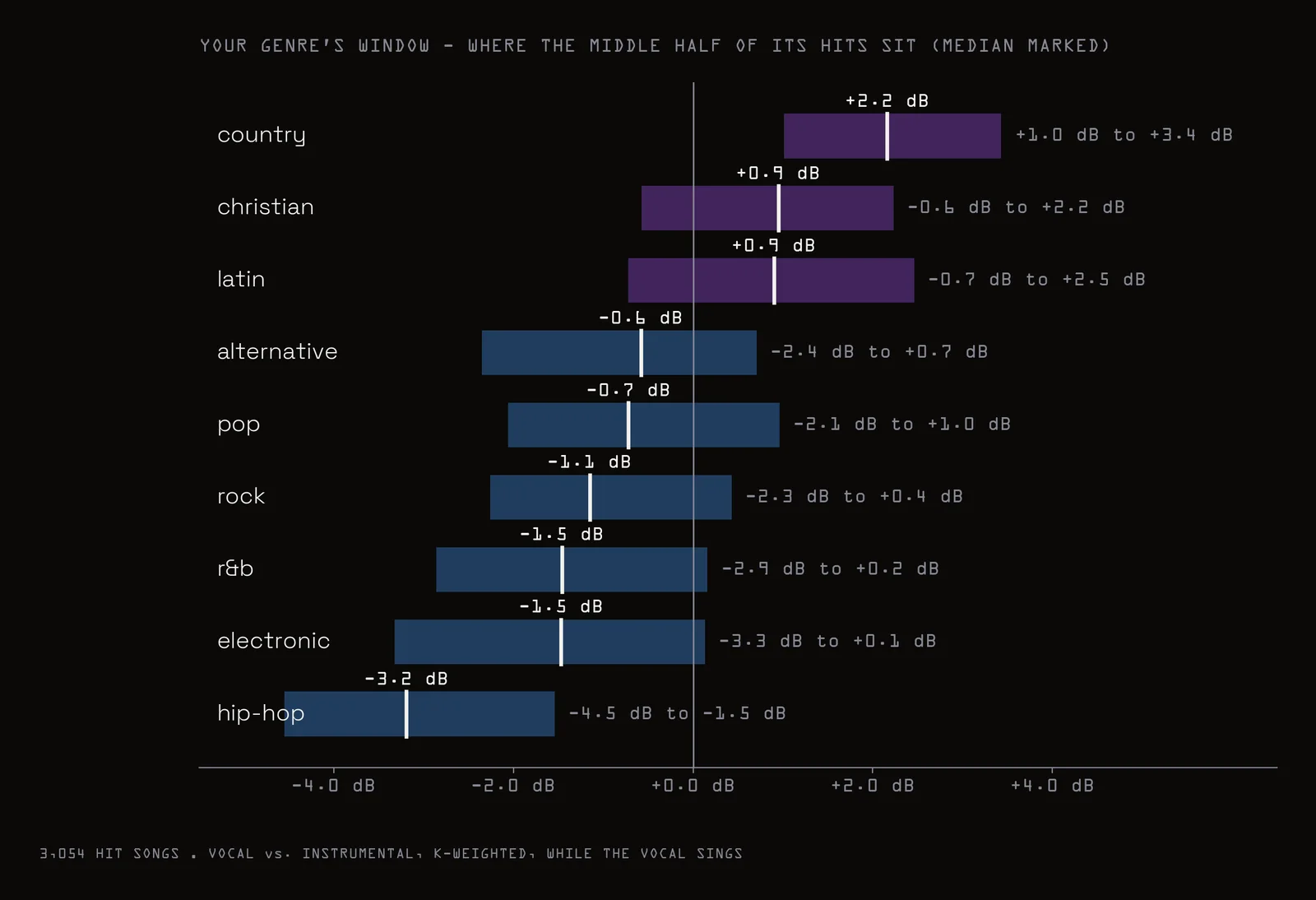
I measured the vocal level of 3,054 Billboard hits against their own instrumentals, only while the vocal is singing. Here’s where they put it, by genre:
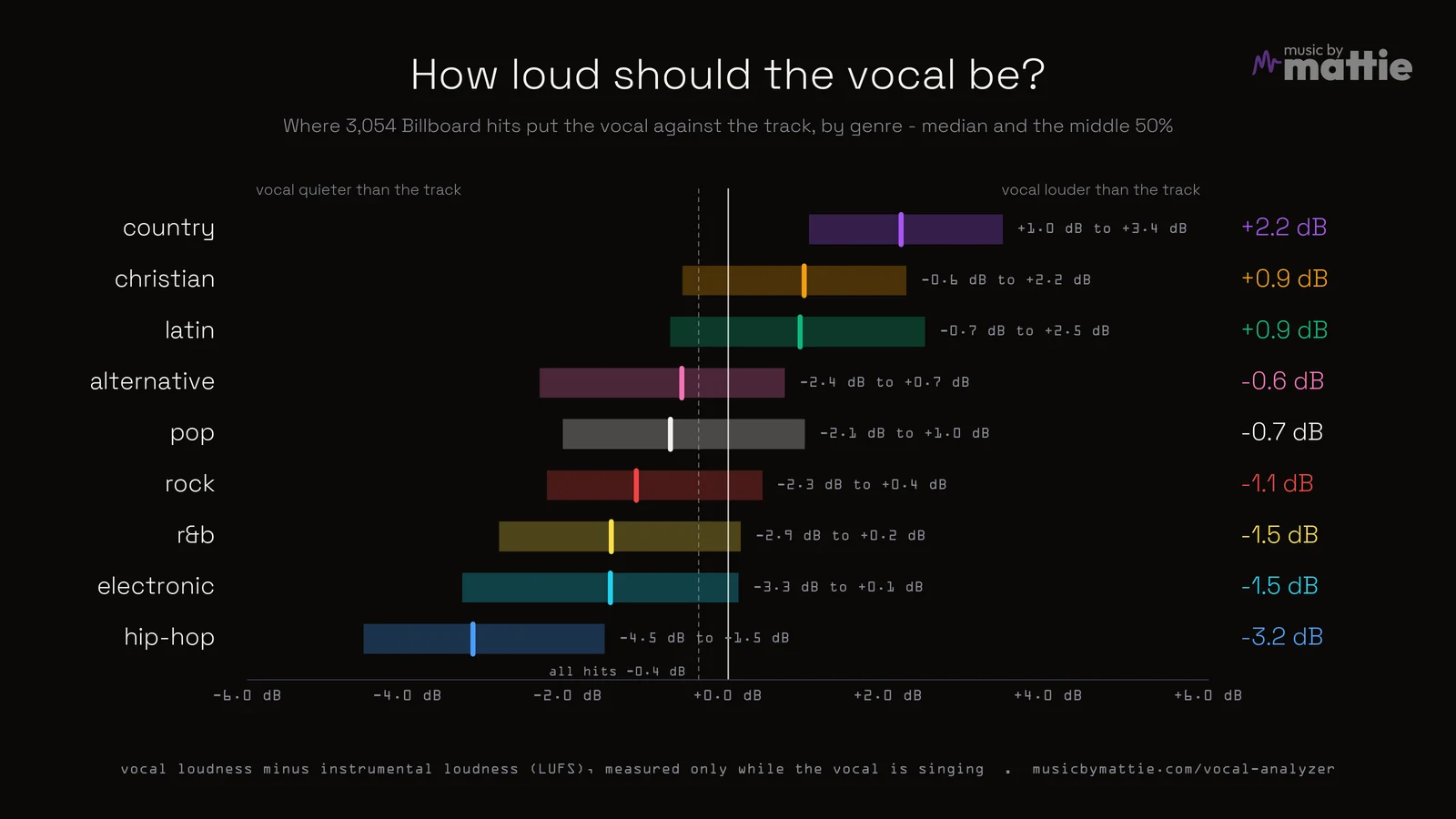
| Genre | Median | Window (middle 50%) | Within 3 dB of the median | Songs |
|---|---|---|---|---|
| Country | +2.2 dB | +1.0 to +3.4 | 91% | 416 |
| Christian / Gospel | +0.9 dB | -0.6 to +2.2 | 79% | 245 |
| Latin | +0.9 dB | -0.7 to +2.5 | 81% | 407 |
| Alternative | -0.6 dB | -2.4 to +0.7 | 76% | 270 |
| Pop | -0.7 dB | -2.1 to +1.0 | 75% | 238 |
| Rock | -1.2 dB | -2.3 to +0.4 | 83% | 311 |
| R&B | -1.5 dB | -2.9 to +0.2 | 80% | 409 |
| Electronic | -1.5 dB | -3.3 to +0.1 | 78% | 414 |
| Hip-hop | -3.2 dB | -4.6 to -1.5 | 80% | 299 |
| All hits | -0.4 dB | -2.3 to +1.5 | 71% | 3,053 |
Every number is vocal loudness minus instrumental loudness, in dB, measured only while the vocal is singing. Positive means the vocal is louder than the track. How to use it: if you make pop and your vocal reads 2 dB louder than your instrumental, you’re outside the window - pull the vocal down, or push the track up, until the difference lands between -2.1 and +1.0, and aim for the median. How to measure your own mix is below, and the free vocal analyzer will do it for you.
The rest of this post is what the number means, why genre moves it by five decibels, and where it comes from.
I also made a full video on this…
All the ideas in this article come from the video below. If you don't feel like reading, well, I gotchu.
How I measured it
I didn’t pull -0.4 out of thin air. It came from analyzing every one of those songs the same way:
- Pulled every Billboard hit since 1990 and downloaded the tracks.
- Ran each one through a stem separator to split the vocal from the instrumental.
- Measured the loudness of both - not peak level, loudness, the way your ears and every streaming service measure it (K-weighted, the same filter behind every LUFS meter).
- Subtracted. Vocal minus track.
Two things had to be right, or every number here would be garbage.
You can’t average the whole song. Avicii’s “Wake Me Up” has no vocal at all for 37% of its runtime - the vocal is literally asleep. Average the whole song and you’d think it’s mixed 2 dB quieter than it is. So every number in this post is measured only during the moments where somebody is actually singing.
Separated stems can lie. The AI that splits a song is very good and occasionally very confident about the wrong thing - it hears the lion roar in “Harlem Shake” as a singer. So I ran the whole thing twice with two different separators, and they agreed. Then I went one step further: I took 150 songs that come with real studio stems, ran the separator on them anyway, and compared. Zero bias. A tenth of a dB. The numbers below are not an artifact of the splitting.
To make the measurement concrete, take TLC’s “Waterfalls.” I have the vocal’s loudness while they’re singing, I have the instrumental’s loudness over the exact same moments, and I subtract. That’s one dot. Do it 3,054 times and you get this.
The answer: -0.4 dB
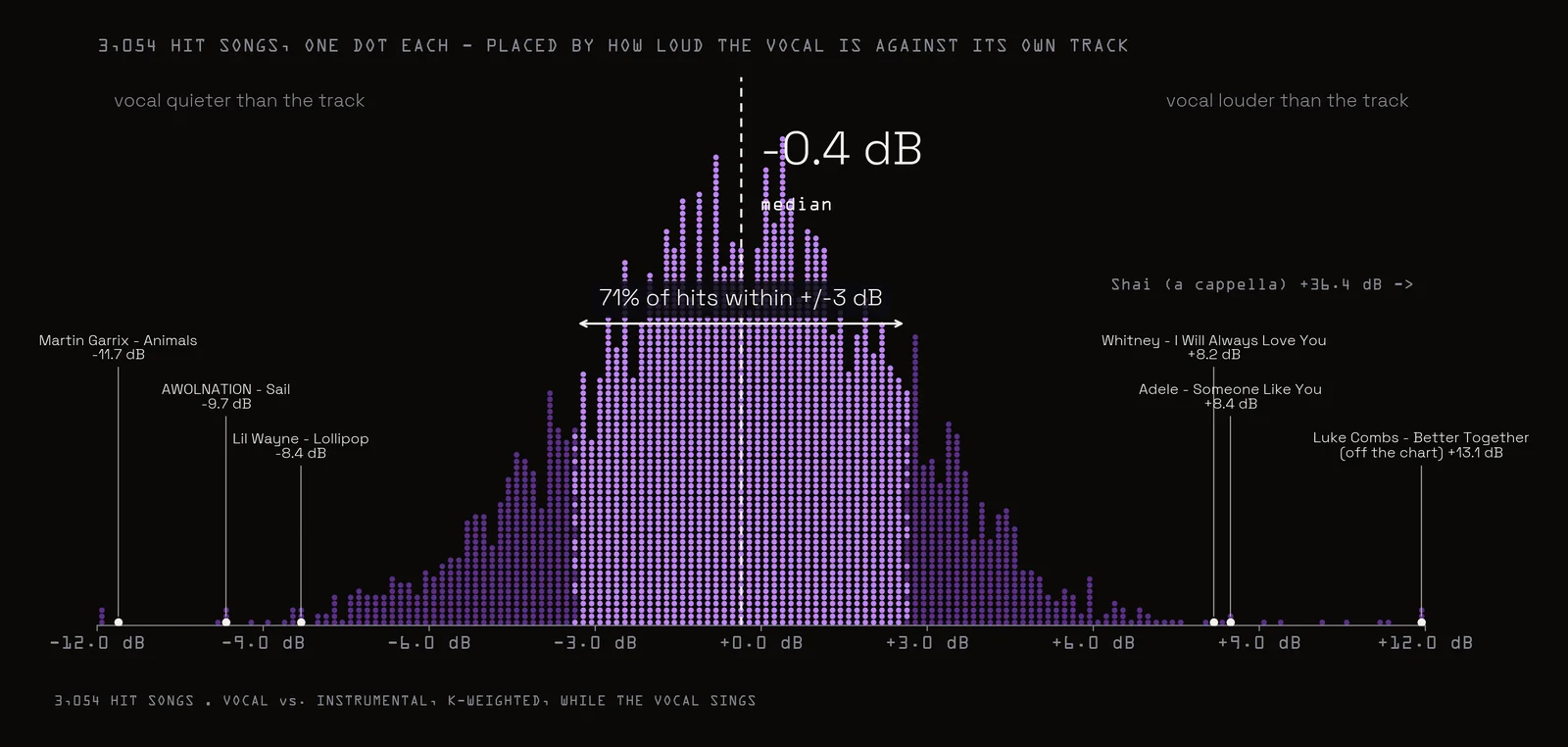
Every dot is one hit, placed by how loud its vocal is compared to its own track. Left of zero, the vocal is quieter than the track. Right, louder. And it piles up into a mountain right around zero.
The middle of the mountain is -0.4 dB. The vocal is basically level with everything else. Not on top. Not in front. Level. If you learned mixing from the internet, that’s probably not what you were told.
And it’s not a knife edge, it’s a window. 71% of every hit in the last 35 years sits within 3 dB of that line, and 41% are within a dB and a half. Thousands of songs, hundreds of engineers, decades of taste, and most of them landed on the same fader position.
So we’re done, right? Set your vocal to -0.4 and go platinum. Not quite. There’s a catch, and it’s a five-decibel catch.
Genre changes everything
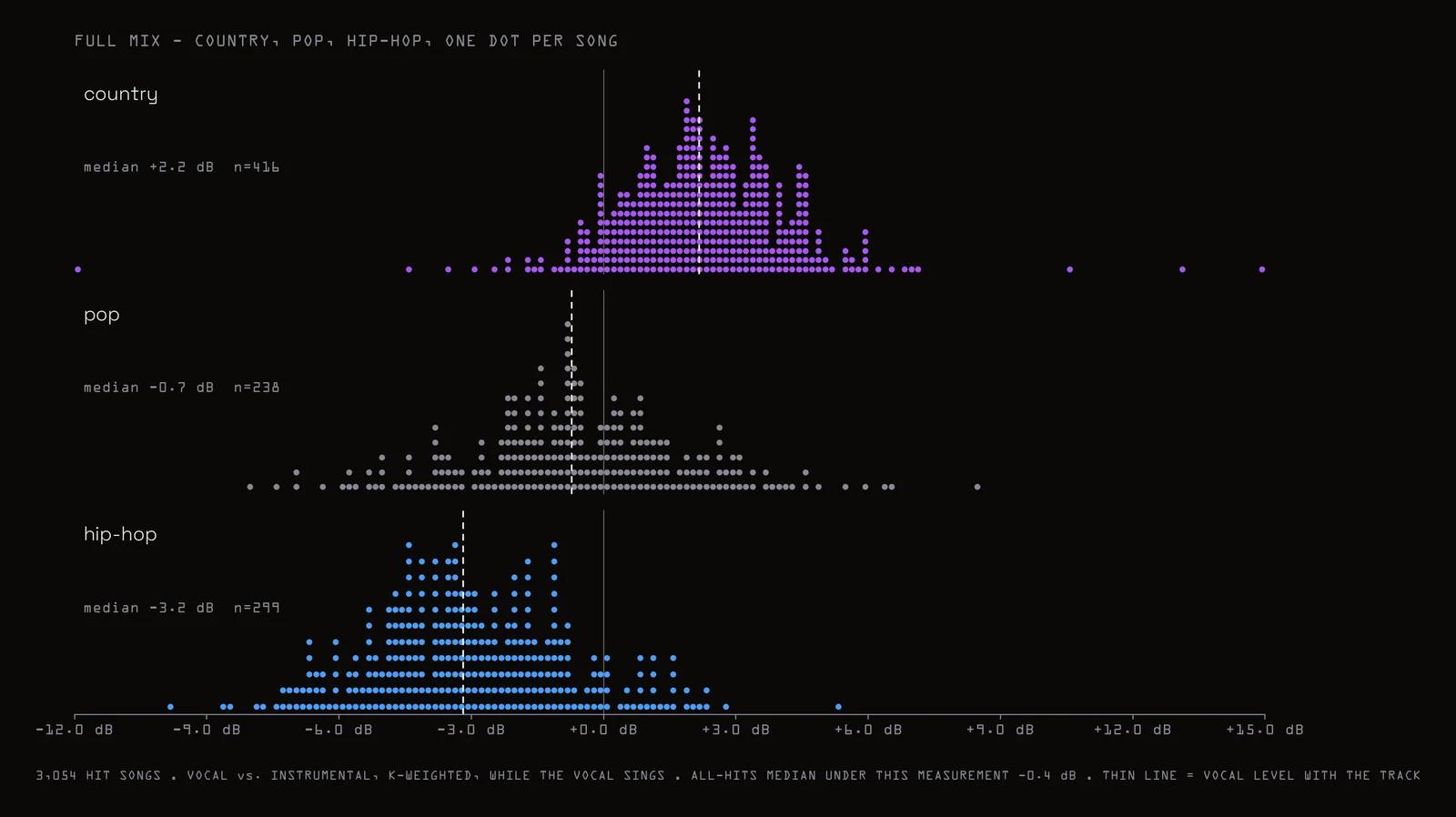
Here’s the same measurement split by genre, one dot per song.
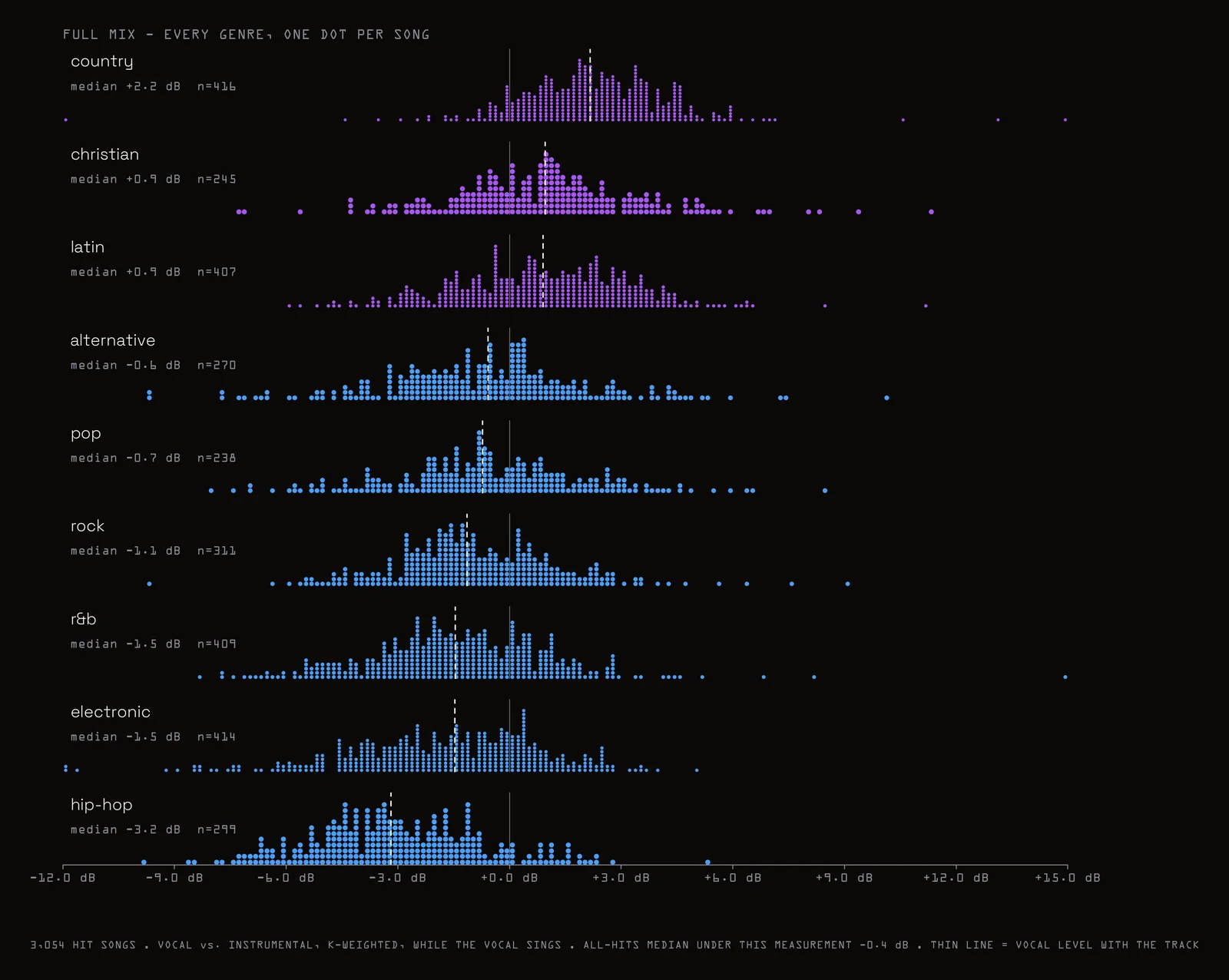
Country vocals sit about 2.2 dB above the track. Hip-hop vocals sit 3.2 dB below it. That’s a 5.4 dB gap between the two, and it’s not a nuance - it’s the difference between a vocal you can’t miss and a vocal you have to find. Pop, rock and alternative sit a little under the track; Christian and Latin a little over.
This is why the genre table above matters more than the one universal number. Remember 71% of hits within 3 dB of -0.4? Measure each song against its own genre’s median instead, and that goes to 81%. Country alone: 91%. Knowing your genre is worth ten points of “this sounds like a record.”
Is it just the bass?
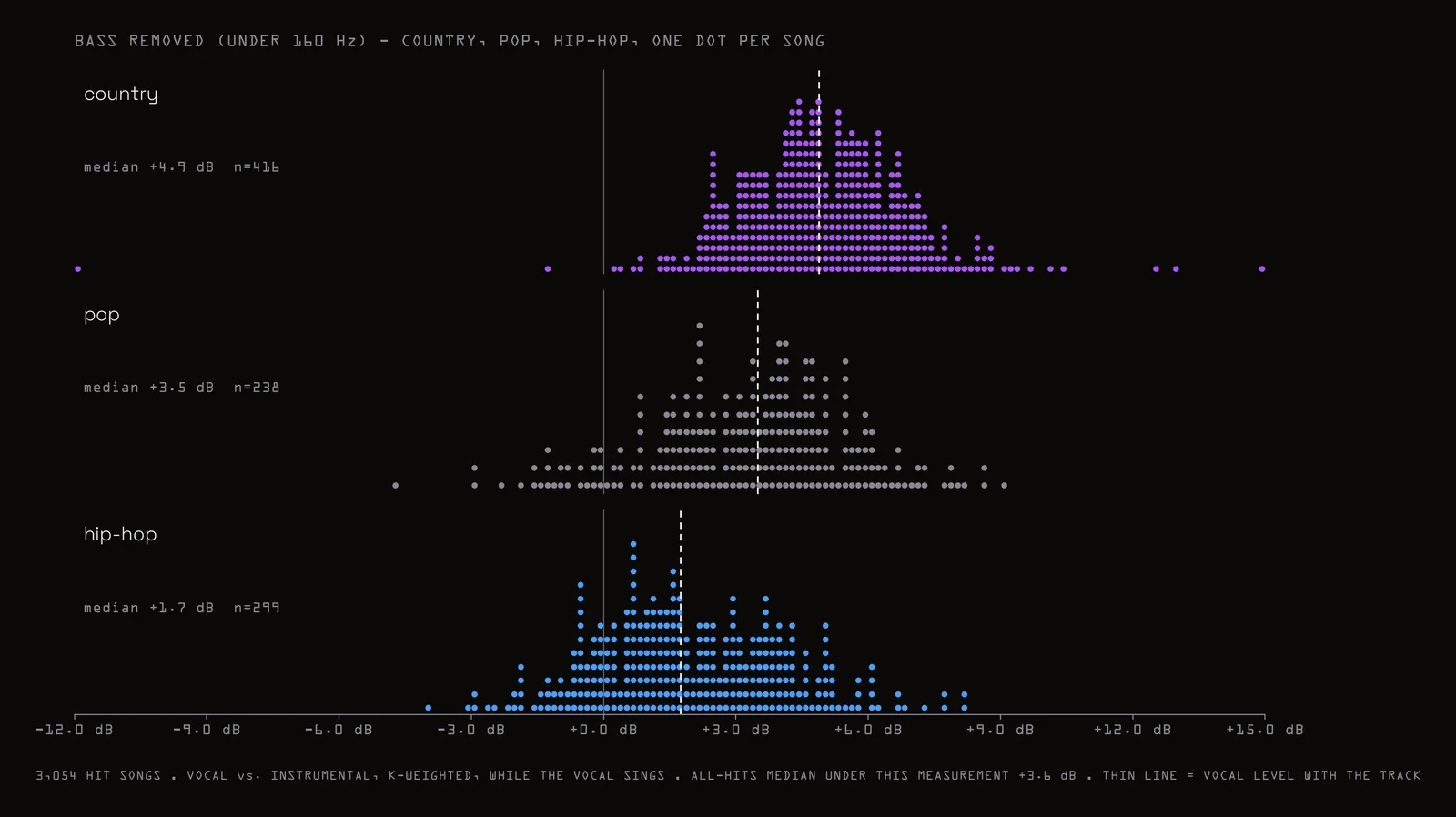
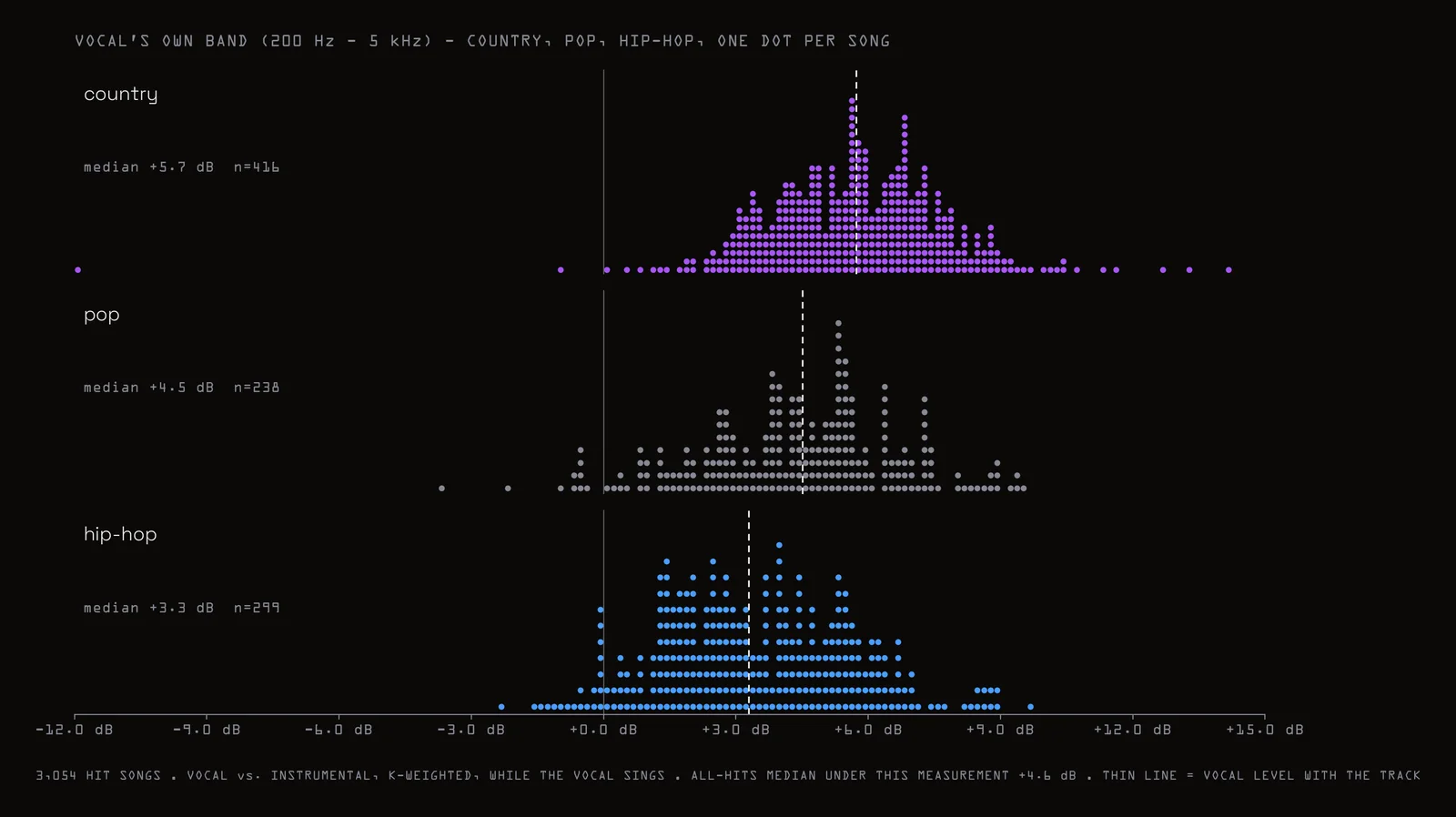
When I first saw the genre gap I had a theory: bass. Hip-hop beats live in the low end, so of course the track measures louder and the vocal reads as buried. So I tested it. I ran the whole measurement again with everything under 160 Hz cut out of every song, and then a third time measuring only the frequencies where a vocal actually lives, 200 Hz to 5 kHz.
Same three genres, three ways of measuring:
| Genre | Full mix | Bass removed (under 160 Hz) | Vocal’s own band (200 Hz - 5 kHz) |
|---|---|---|---|
| Country | +2.2 | +4.9 | +5.7 |
| Christian / Gospel | +0.9 | +4.4 | +5.1 |
| Latin | +0.9 | +4.0 | +5.1 |
| Alternative | -0.6 | +3.7 | +4.7 |
| Pop | -0.7 | +3.5 | +4.5 |
| Rock | -1.1 | +2.8 | +3.6 |
| R&B | -1.5 | +3.2 | +4.5 |
| Electronic | -1.5 | +3.0 | +4.0 |
| Hip-hop | -3.2 | +1.7 | +3.3 |
| Country-to-hip-hop gap | 5.4 dB | 3.1 dB | 2.4 dB |
Three things fell out of that:
- About half of the genre gap is the 808s. Take the low end out of the measurement and the gap shrinks from 5.4 dB to 3.1. Look only at the vocal’s band and it’s 2.4.
- The other half is a choice. Country still mixes the vocal hotter with the bass gone. That’s not physics - that’s the genre deciding where the singer stands. (And no, it’s not because rap is choppier: I measured peaks instead of averages and hip-hop is still the most buried genre.)
- In its own lane, the vocal is always on top. Between 200 Hz and 5 kHz, every genre puts the vocal about 4 dB above the track, all within a couple of dB of each other. In the full mix only 45% of hits have a vocal louder than the track; in the vocal’s own band it’s 96%. The genres don’t really disagree about the vocal. They disagree about how much bass to put under it.
The ones that moved out of the window
The window is where most hits live. These are the famous ones that didn’t.
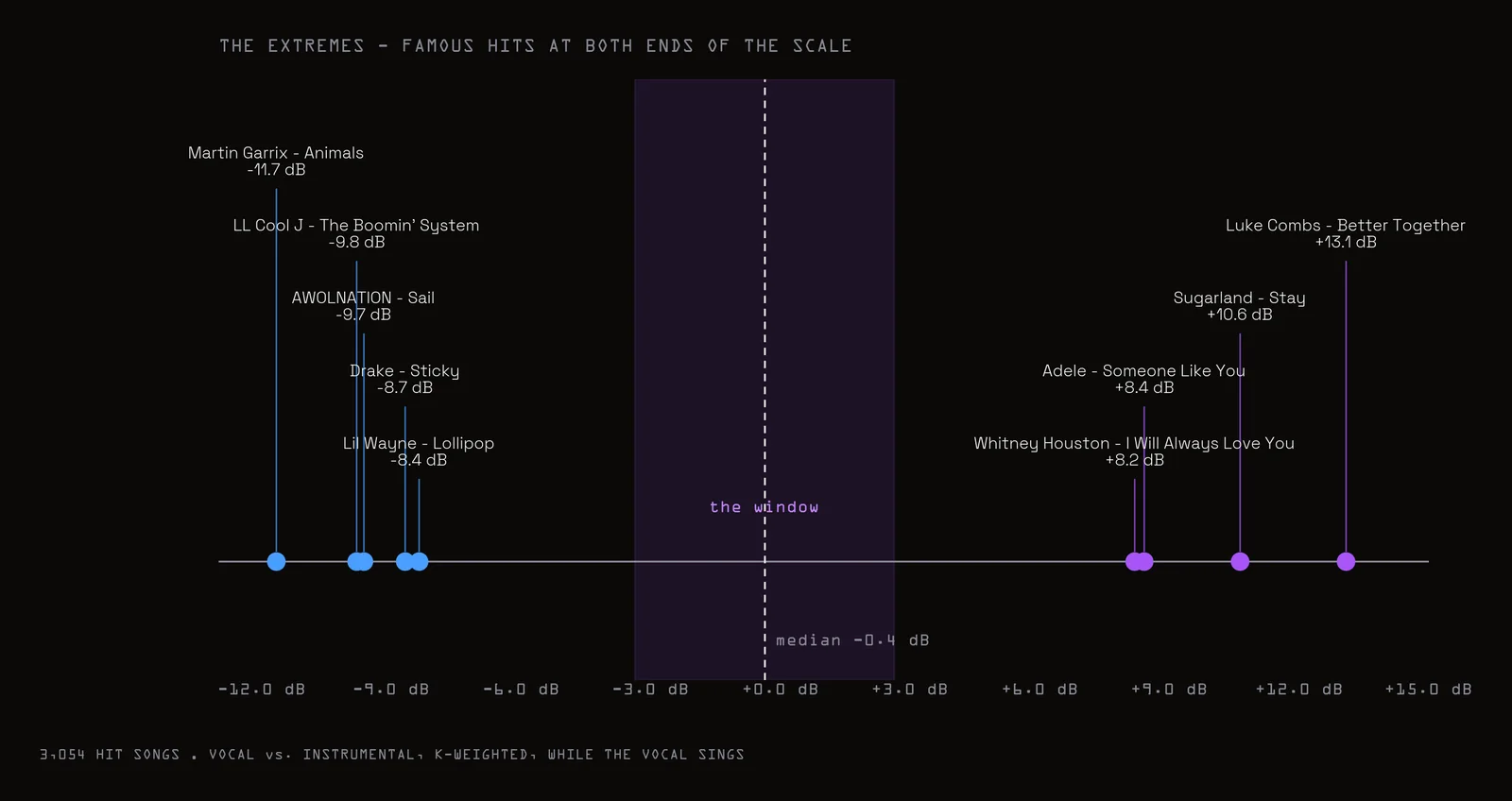
Vocal-forward: Whitney Houston, “I Will Always Love You,” about +8 dB. Adele, “Someone Like You,” +8.4. Sugarland’s “Stay,” +10.6. And the champion, Luke Combs’ “Better Together” at +13.1 - a vocal with a guitar somewhere behind it.
Buried: Lil Wayne, “Lollipop,” -8.4. Drake, “Sticky,” -8.7. AWOLNATION, “Sail,” -9.7. LL Cool J, “The Boomin’ System,” -9.8 - and that one went to number one. Martin Garrix, “Animals,” -11.7, which is less a vocal and more a rumor.
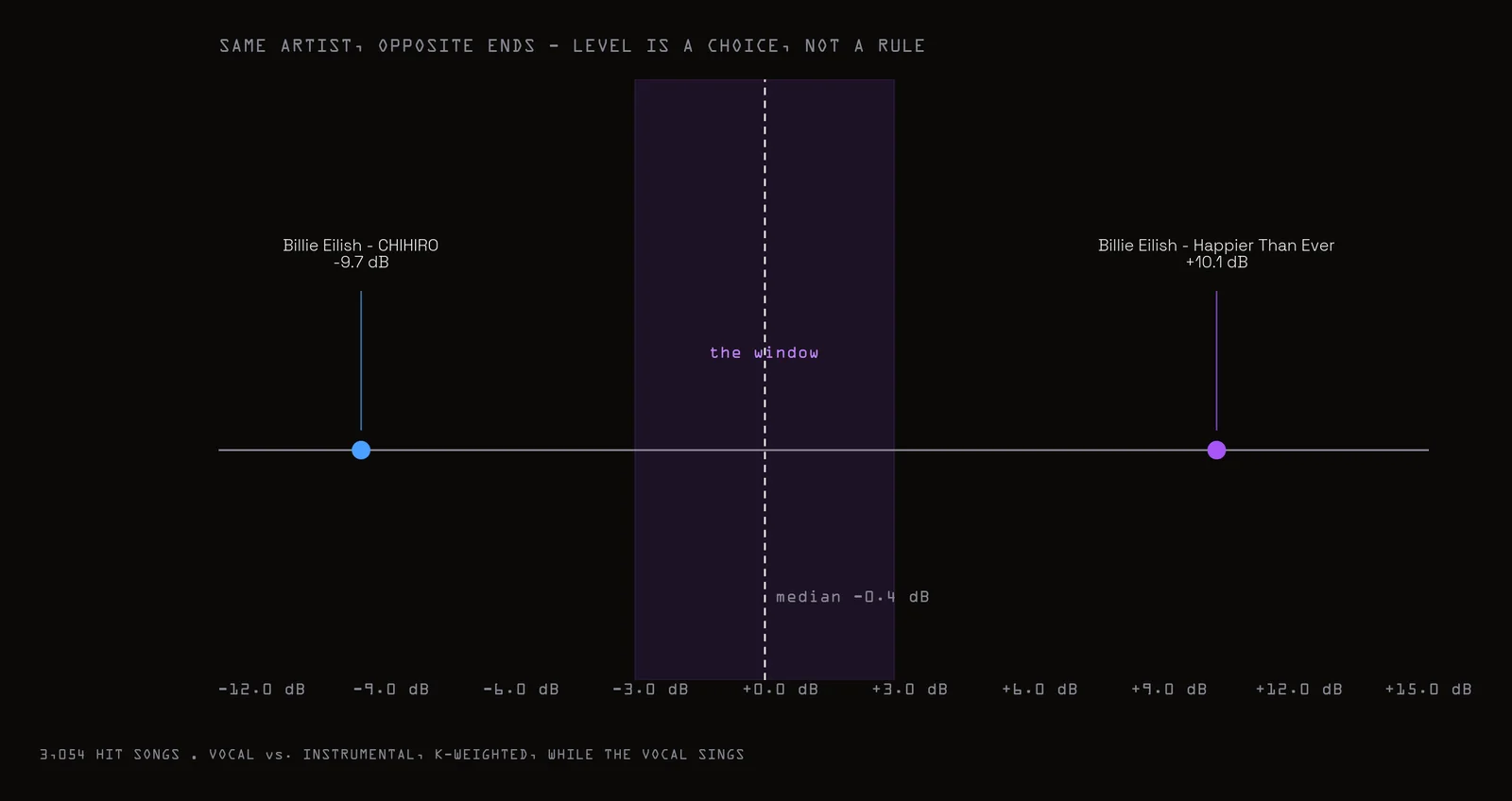
My favorite part: one artist is on both lists. Billie Eilish. “Happier Than Ever” sits at +10.1 (the quiet half carries the whole song). “CHIHIRO” sits at -9.7. Same singer, same producer, twenty decibels apart. For Finneas, level isn’t a rule. It’s a choice.
And the single most vocal-forward hit ever measured? Shai, “If I Ever Fall in Love,” at +36 dB. Because it’s a cappella. There is no track. The system had no idea what the song was, and it got it exactly right.
How to measure your own mix
Three steps, and you can do it tonight with any LUFS meter (the free ones are fine).
- Meter the vocal. Put a loudness meter on your vocal bus and read it during a section where the vocal is actually singing - a chorus, not the intro. Use the integrated reading over that section. If you have a lot of vocal tracks, route them to a vocal bus and meter that.
- Meter the instrumental. Same meter, same section, with the vocal muted (everything except the vocals). You can do both readings with your master chain on - I tested it, and at normal mastering levels (1-3 dB of limiting) soloing through the chain reads within about half a dB of the true in-master balance, always erring slightly hot on the vocal. Two footnotes: if you limit hard (5+ dB of gain reduction) the reading runs about a dB hot, so aim a touch low; and if you want to match the hits exactly - they were measured by splitting finished masters - bounce your master, run it through a stem splitter (Logic Pro 11 has one built in), and meter the split vocal against the split instrumental. On my own mix that agreed with the true number to within 0.2 dB.
- Subtract. Vocal minus instrumental. That’s your number. Compare it to your genre’s window in the table at the top. If you’re at +2 and you make pop, pull the vocal down about 2.5 dB (or bring the track up) and you’re on the median.
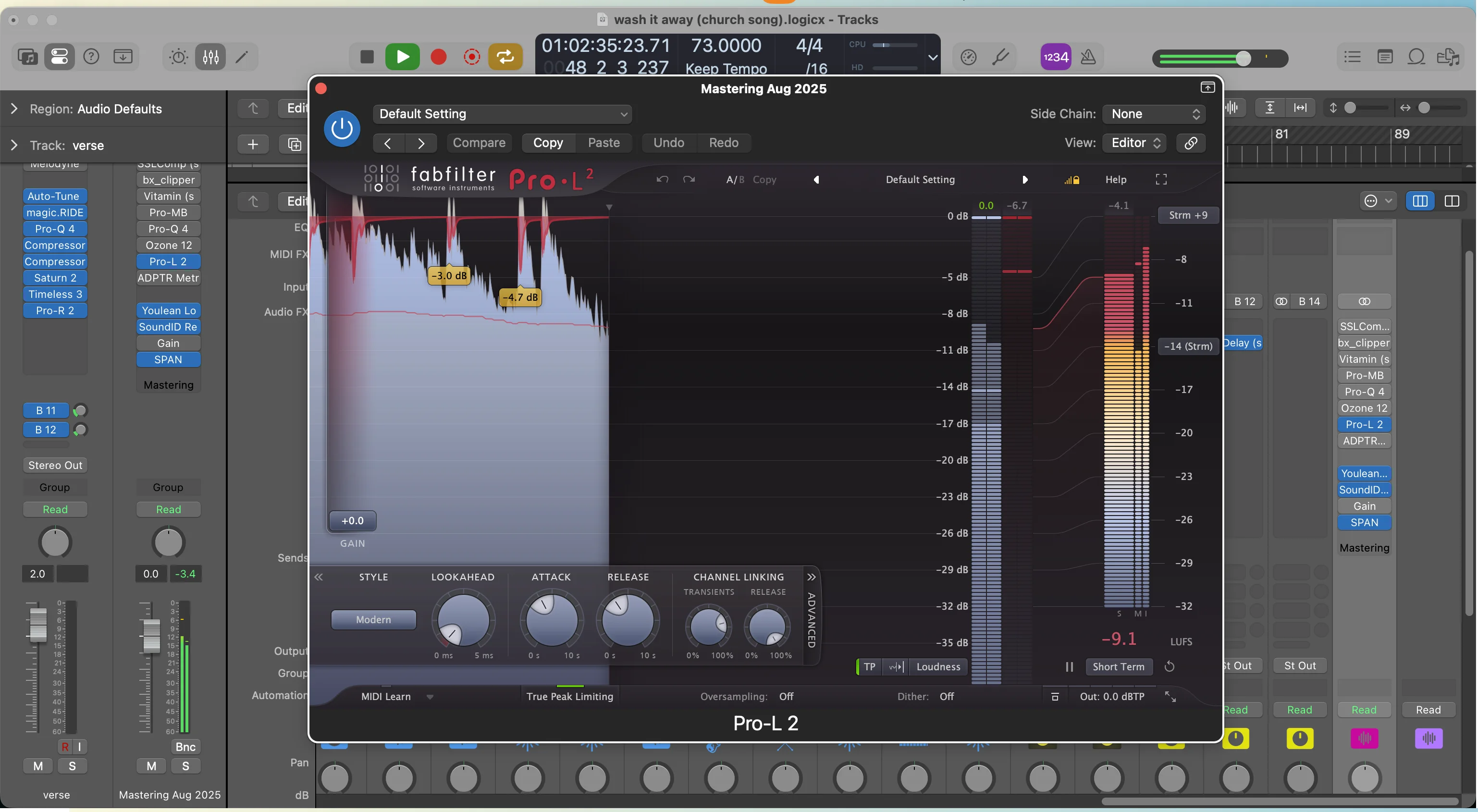
For reference, my own mix read -12.7 LUFS on the vocal and -12.8 on the instrumental: +0.1 dB, inside the pop window, a smidge above the median.
Then keep it there. This number is measured while the vocal sings, and vocals move - verses get quiet, choruses get loud, one word jumps out. You can set the fader perfectly at bar one and be out of the window by bar nine. That’s what magic.RIDE is for: it holds the vocal at the level you set for the whole song, riding it the way an engineer would with a hand on the fader, without squashing it.
Or let the analyzer do the math
If all of that is “Mattie, I’m not doing math,” the free vocal analyzer now does this for you. Upload your vocal and it measures it the exact same way I measured these 3,054 hits and tells you what your instrumental should read to land in your genre’s window. Add your instrumental (or the full mix) as a second file and it grades your actual balance against your genre - and against every other genre.
The honest caveats
- Every number is measured while the vocal sings, not as a full-song average. Meter yours the same way.
- The genre numbers are medians of hits, not laws. Billie is on both ends of the chart on purpose.
- Songs with two very different halves get averaged. “Happier Than Ever” reads +10 because the quiet half carries it.
- Per-song numbers carry about a dB of measurement noise. The medians and the windows don’t - the same measurement on 150 songs with real studio stems came out with zero bias.
-0.4 dB isn’t a rule. It’s where 3,054 hits landed. Now you know where you are.
Tired of riding vocal levels by hand? My magic.RIDE plugin auto-levels your vocal performance in one pass - drop it on the track, hit auto-target, and your dynamics are sorted before the compressor even sees the signal.
About Mattie
Mattie is a music producer, songwriter, and educator specializing in Logic Pro and vocal production. With over 10 years of experience in the music industry, he's helped thousands of artists transform their home studio recordings into professional-quality tracks.
As the founder of Music By Mattie, he creates tutorials, presets, and courses that simplify complex production techniques. His mission is to make professional music production accessible to everyone, regardless of budget or experience level.